Teach systems through systems
The course itself models decomposition, interfaces, iteration and verification rather than presenting those ideas as isolated definitions.
02Curriculum architecture · teaching · software

The problem
A new senior syllabus needed more than lesson notes. Teachers and students needed a coherent path from outcomes to explanation, practice, projects, assessment and revision.
Subject expert, curriculum architect, author, developer and verifier.
Constraints
What I built
The course itself models decomposition, interfaces, iteration and verification rather than presenting those ideas as isolated definitions.
Students can see where a concept belongs, what it connects to and how it will be used.
Naming, structure, validation and revision are managed as an engineered product.
Measurable proof
course routes in the current application
staged programming projects
linked practical labs
public handbook listing
Primary record ↗The working course home: two years of learning exposed as one navigable system.
Stage 6 Software Engineering publishing repository · public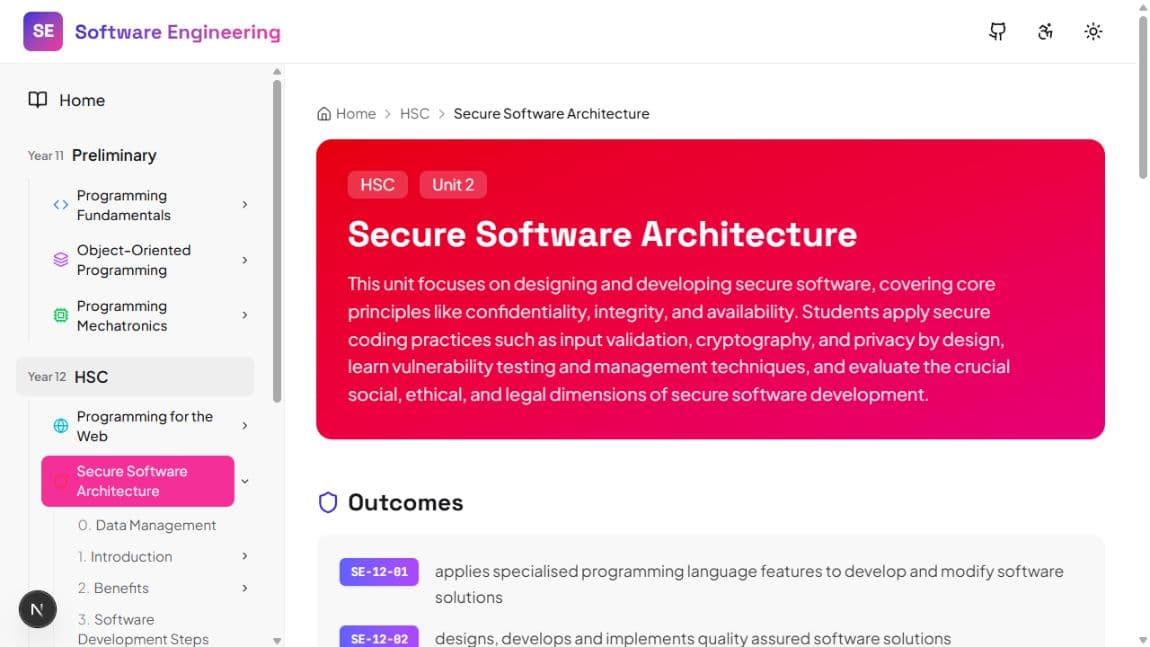
A complete HSC unit: outcomes, objectives, topics and practical security work inside the shared course architecture.
Stage 6 Software Engineering application; privacy-safe local capture · public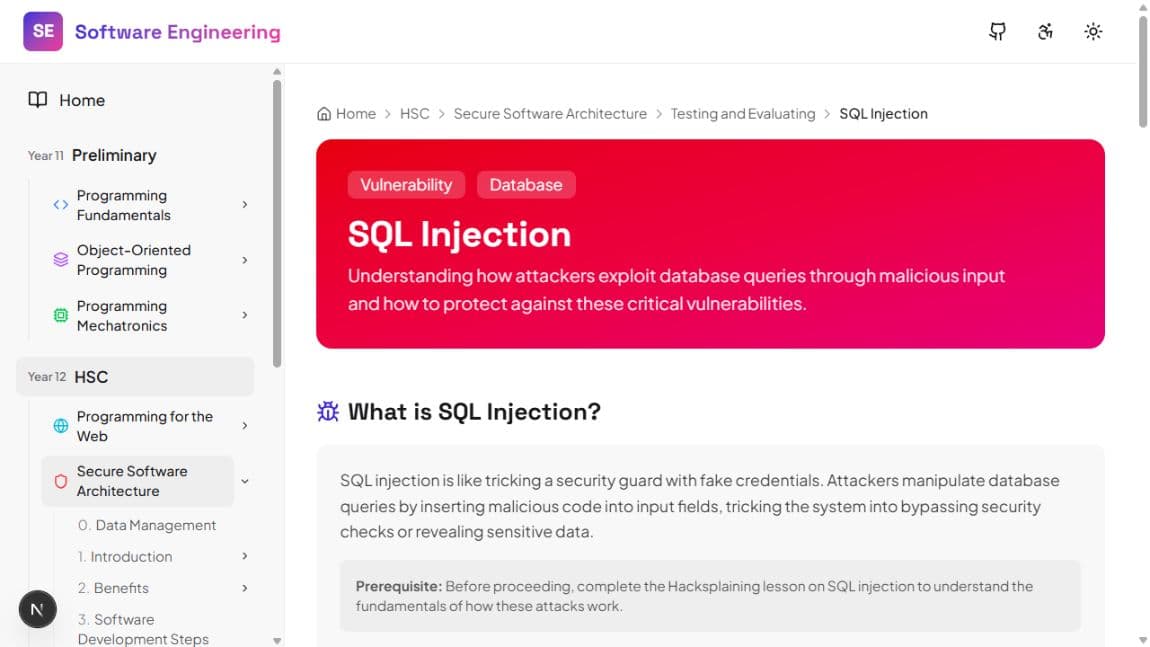
A practical security lab moves from the vulnerability model to attack patterns, safe testing and defensive code.
Stage 6 Software Engineering application; privacy-safe local capture · publicWhat the work taught
01Curriculum coherence matters more than content volume.
02A learning system should help a teacher see the next move, not just store resources.
03Verification belongs in educational publishing as much as it belongs in software.